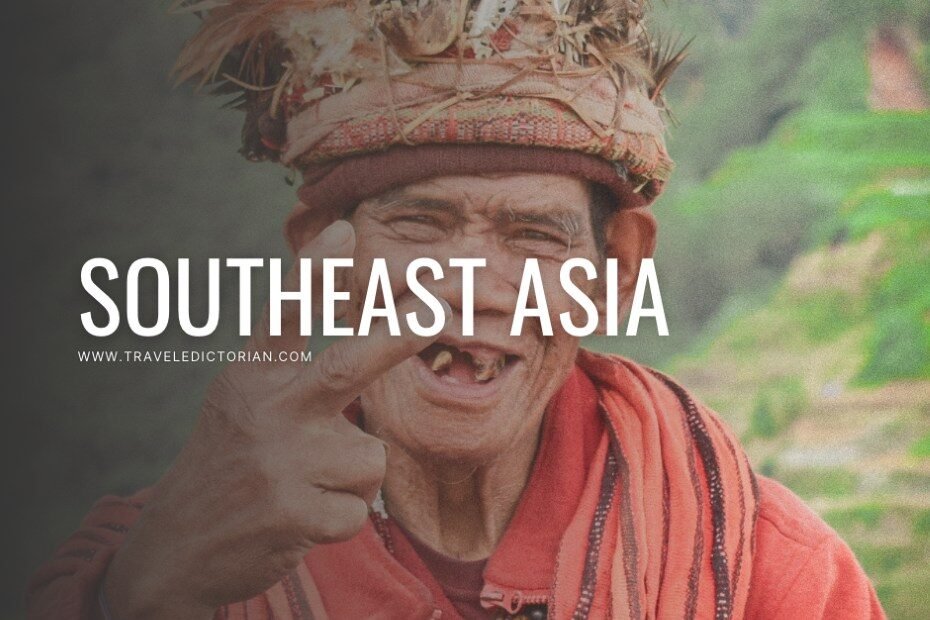
This article, “33 Intriguing Travel-Related Facts About Southeast Asia,” features information, adding a layer to understanding the rich tapestry of the Asian subregion.
Disclaimer: This travel guide contains information that is subject to frequent updates. That being said, if you opt to read this article further, you consent to verifying facts with the relevant authorities. Please review the full terms of this website.
Introduction
Southeast Asia is a tourist destination with a multitude of fascinating places. There are breathtaking islands and beaches, deeply-ingrained traditions, ancient architectures, and modern cityscapes across this uniquely Asia.
Moreover, a trip to Southeast Asia would not be complete without tasting the wide variety of the subregion’s abundance of indigenous delicacies. Every country presents a palate-pleasing, distinctively amazing taste of Asia, which makes this tropical hideaway for food lovers.
Intriguing treasures abound in Southeast Asia. The Asian subregion will never cease to surprise you with its broad array of natural wonders and historical and cultural wealth. Here are the 33 intriguing travel-related facts about Southeast Asia:
Climate and Topography
- Indonesia, which is located directly on the Circum-Pacific Belt, has the most active volcanoes, with at least a hundred. Mount Merapi, situated in Central Java, has the highest frequency of volcanic eruptions in the country since 1548.
- With over 17,000 islands, Indonesia is the largest archipelagic country in the world, of which around 6,000 islands are inhabited, including Bali.
- Java, Indonesia, the precise location of the capital, Jakarta, is the most populated island in the world, with nearly 160 million inhabitants. The population of the island exceeds that of all of Russia, making it as one of the most interesting facts about Southeast Asia.
- Manila, the capital of the Philippines, is generally recognized as the world’s most densely populated central city, with a population density surpassing 46,000 inhabitants per square kilometer.
- Batangas has an unusual topographical feature where an islet (Vulcan Point) rests inside a lake (Main Crater Lake on Volcano Island), which is located inside a lake (Taal Lake) on a major Philippine island (Luzon).
Customs and Laws
- The Cambodian flag, which highlights the most recognizable emblem of the country, Angkor Wat, is the only one in the world to feature a building.
- The Philippines is the only country in the world where the flag is deliberately reversed to indicate a state of war, with the red horizontal band above instead of blue.
- Since 1992, Singapore has banned the importation and sale of chewing gum, with the exception of medical use, due to the city’s chewing gum litter problem in public spaces. As such, those who violate the law risk a hefty fine or face imprisonment.
- Jack Sim, a Singaporean entrepreneur and philanthropist, founded the World Toilet Organization (WTO). Since its inception on November 19, 2001, the Singapore-based mission-driven movement has launched initiatives about global toilet sanitation.
- Bangkok holds the longest city name in the world, with a staggering 168 words. Its official ceremonial name is “Krung Thep Mahanakhon Amon Rattanakosin Mahinthara Yuthaya Mahadilok Phop Noppharat Ratchathani Burirom Udomratchaniwet Mahasathan Amon Piman Awatan Sathit Sakkathattiya Witsanukam Prasit,” which translates to “City of Angels.”
- In Thailand, intentionally stepping on Thai currency, bearing the monarchical likeness, is unlawful. as such, those who go against the law run at risk of committing a serious criminal offense.
Events
- The Philippines is widely recognized as the country with the longest celebration of Christmas that extends slightly over four months. This festive season formally kicks off from September through early January, where Christmas bustles are clearly visible all around.
- Thailand celebrates the traditional Thai New Year, officially called “Songkran,” with the world’s biggest waterfight. The deeply chaotic three-day event, which happens from April 13 to 15, is packed with millions of people geared with water guns, rushing waters to anyone nearby.
Food and Retail
- With over 450,000 locations, Indonesia has more coffee shops than anywhere else in the world.
- Opened in 2009, the Liao Fan Soya Sauce Chicken Rice and Noodle, often known as Hawker CHAN, is widely considered the world’s most affordable Michelin-starred restaurant. Its inaugural branch in Singapore, serves signature Cantonese flavor, priced from SGD 3.50 or USD 2.76.
- Bangkok is home to Chatuchak Market, or simply the “JJ Market,” which is generally recognized as the world’s largest open-air marketplace. The 35-acre market square hosts more than 15,000 independent stalls, offering a wide range of goods.
- Thailand produces the most expensive coffee worldwide, the “Black Ivory Coffee.” The partially digested Arabica beans from elephants cost a whopping USD 3,000 per kilogram.
Lodging
- The First World Hotel in Genting, Malaysia is named the world’s largest hotel in terms of room inventory. The enormous 3-star property boasts an overwhelming count of 7,351 rooms across its strikingly identical buildings.
Places of Interest
- Istana Nurul Iman, located in the Bruneian capital, Bandar Seri Begawan, is home to the world’s largest residential palace. The sultanate’s official residence spans a floor space of 200,000 square meters, with at least 1,700 rooms, 250 bathrooms, and 5 swimming pools. In addition, it has over a hundred garages that house a staggering count of 7,000 vehicles.
- The world’s largest religious monument is found in Cambodia, the Angkor Wat, which covers an enormous area of 400 acres. This ancient Buddhist temple is larger than Vatican, the smallest independent country in the world.
- Borobudur, which rests on the lowlands of Central Java in Indonesia, is the largest Buddhist temple in the world. This massive ancient stepped pyramid built from two million gray volcanic stones occupies a surface area of 15,000 square meters and stands at a height of 34.5 meters. It is embellished with over a thousand sculpted plaques and contains slightly more than 500 Buddha statues.
- Laos is the most heavily bombed country throughout history. During the Vietnam War, between 1964 and 1973, U.S. forces launched air raids of over 2 million tons of bombs – more than all the bombs dropped during World War II combined – on the landlocked country, contaminating various locations with unexploded bombs.
- The Petronas Twin Towers, which spans a commanding height of 451.9 meters, remain the tallest identical structures in the world. This soaring engineering feat in the heart of Malaysia’s thriving capital houses offices and retail spaces.
- Malaysia boasts the largest cave chamber in the world terms of surface area, the Sarawak Cave Chamber, spanning a touch over 160,000 square meters. It is thought to be large enough to hold dozens of jumbo jets.
- Bagan, an ancient kingdom in Myanmar, contains the greatest concentration of Buddhist religious monuments, with a staggering number of at least 2,200 extant structures dispersed across an area of 40 square miles. It was inscribed on the UNESCO World Heritage Site list for its wealth of temples, pagodas, and stupas, like the largest temple, the Dhammayangyi, which dates back to the 11th to 13th centuries.
- Binondo in Manila, is widely recognized as the oldest Chinatown in the world. It was founded in 1594.
- Palawan, located in the Philippines, boasts the world’s longest navigable underground river, the Puerto Princesa Subterranean River. The UNESCO World Heritage Site and the New Seven Wonders of Nature stretch slightly over 8 kilometers long and feature dramatic geological formations.
- The Night Safari in Singapore is the first nocturnal zoo/safari in the world. Over a hundred fauna species, 40% of which are endangered, are sheltered in the expansive open-range wildlife park that uses artificial light sources.
- Singapore has the tallest indoor waterfall in the world, the HSBC Rain Vortex. This contemporary marvel that descends forty meters through a hemispherical geometric glass ceiling is precisely located right at the center of the Jewel Changi, a nature-inspired retail and recreation complex in Singapore’s main gateway.
- Vietnam boasts the largest natural cave in the world in terms of physical space, the Son Doong Cave, which measures nearly 39 million cubic meters and stretching 9 kilometers. This tremendous subterranean geological wonder, specifically located in the lush forests of Quang Binh Province, has its own ecological system and weather elements.
Transit
- The entire highway network of Malaysia spans over 65,000 kilometers, surpassing even the circumference of the Earth.
- Malaysia’s Putrajaya Roundabout holds the world’s longest roundabout, with a total length of roughly 3.5 kilometers. It takes a 3.5-minute drive to encompass the circular road junction.
- The world record for the longest non-stop cable car is held by the Hon Thom Cable Car, measuring a staggering length of 8,000 meters. This coastal aerial tramway links Vietnam’s southern islands of Phu Quoc and Hon Thom in 15-20 minutes.
Did I quench your curiosity about the 33 travel-related facts about Southeast Asia? I’d love to hear what caught your attention the most. Share your thoughts in the comment section.

About the Author
J. Sac is the author of “33 Intriguing Travel-Related Facts About Southeast Asia.” He is also the founder of Traveledictorian – a travel blog that publishes well-thought-out travel content.
His passion for writing, photography, and travel fueled him to explore Asia and the rest of the world. He also plans to undertake humanitarian work in his travels. Read his inspiring story and follow him on social media!
P.S. Subscribe to our newsletter for the newest travel guides and the latest updates in the travel industry.