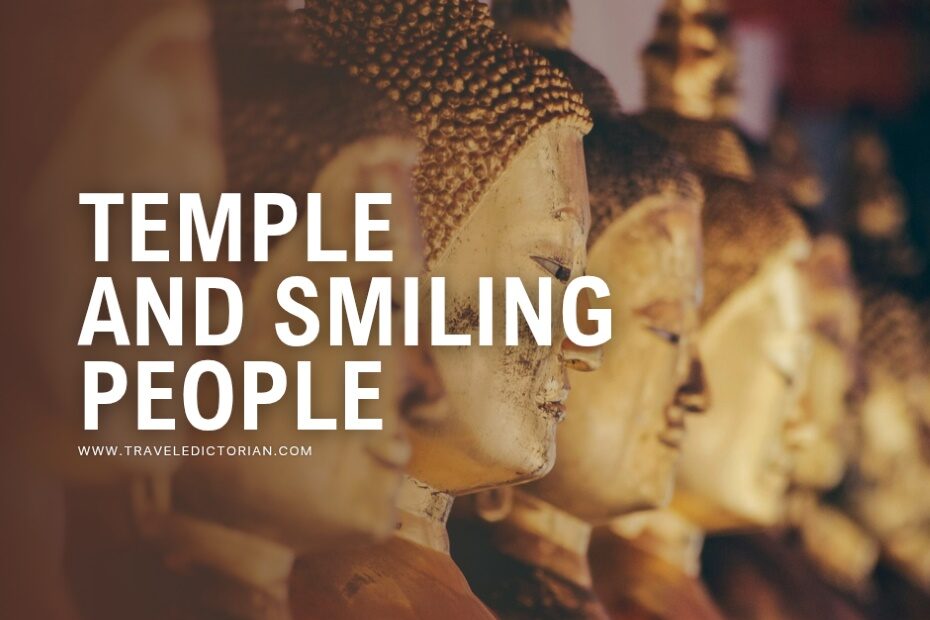








This “Bangkok Travel Guide” has a carefully considered itinerary and a detailed travel budget to help you make the most of your two days in the city.
Disclaimer: This travel guide contains information that is subject to frequent updates. That being said, if you opt to read this article further, you consent to verifying facts with the relevant authorities. Please review the full terms of this website.
Bangkok was my first-ever international destination, following years of journeying throughout the Philippines. The Thai capital remains a traveler’s paradise for its blend of cultural landmarks, culinary traditions, retail venues, and its welcoming locals who shape the city’s distinctive character and pulsating urban atmosphere.
The city’s Buddhist temples and shrines are dense in Rattanokasin and Thonburi, where I arrived with an enormous crowd. These majestic “wats,” which bear witness to the depth of Thai culture and history, appeal to millions of visitors each year.
Moreover, a trip to Bangkok would not be complete without indulging in its traditional Thai cuisine. A wide spectrum of delectable dishes, both from fine dining restaurants and street food stands, is within reach in this Asian gastronomic hotspot.
Bangkok is also a retail wonderland with a multitude of shopping malls, open-front stands, night markets, and floating markets, all of which offer a broad range of goods. Situated kilometers away from the capital, Thailand’s most popular Damnoen Saduak Floating Market provides a unique shopping expedition.
Beyond its impressive temples and shrines, drool-worthy fare, and countless markets, Bangkok has a way more to offer. Adoring the Thai people who consistently sport their smiles is one thing, though!
Disclosure: This post contains affiliate links. When you make purchases through these links, I receive small commissions at no extra cost to you.
During the 19th century, Bangkok was historically dubbed the “Venice of the East.” The Thai capital has over a thousand canals, serving as transportation channels.
Holders of foreign passports intending to visit Thailand should contact the Embassy of Thailand as to entry requirements. Instead, consult iVisa.com, a reputable and trusted visa service provider.
Philippine passport holders traveling for tourism in Thailand are visa-exempt for a maximum of 30 days. In the event of a visit extension, you are required to apply for a visa.
Having a valid passport and round-trip airline tickets does not guarantee entry into a foreign country. Travelers must go through immigration procedures.
The Coordinated Universal Time (UTC) in Bangkok is UTC +07:00.
As such, Bangkok is three hours ahead of Dubai, five hours ahead of Paris, and six hours ahead of London. Moreover, Bangkok is eleven hours further ahead of New York. Conversely, Bangkok is three hours behind Sydney, two hours behind Tokyo and an hour behind Manila.
Bangkok features a tropical climate, which is common in countries close to the equator. Much like the rest of Southeast Asia, the city receives stagnant warm temperatures, high humidity, and an abundance of rain.
Bangkok has three distinct seasons: the hot, wet, and dry seasons. Whether you want to partake in the water fight festival during the summer, visit its range of indoor attractions in the rainy season, or explore temples and shrines during the dry season, Bangkok has a tropical charm that complements well with its varying seasons.
In Bangkok, the hot season runs from March to May, where visitors may likely experience high temperatures and oppressive humidity, especially in April, the hottest month. Thus, gear up as the Thai New Year, or “Songkran Festival,” takes place from April 13 to 15.
Visitors to Bangkok may anticipate overcast skies and torrential rains from June through October, with September being the wettest. Thus, indoor shopping can be an alternative for all-day persistent rainfall.
The months from November to February, or the dry season, are the best time to visit the Thai capital due to its pleasant weather. It is usually characterized by reduced levels of temperatures and humidity, together with a barely chance of rain, which makes it more ideal for many outdoor activities. Bangkok’s dry period usually pulls in crowds of tourists, specifically January, the busiest month.
Thai, specifically Central Thai, is the official and predominantly the spoken language in Bangkok, Thailand. As a standard practice, male speakers end a sentence with “khap” while women use “ka” to show basic civility.
Here are essential Thai words and phrases to learn before your trip to Bangkok:
Abbreviated as THB, the Thai Baht, is the official currency in Thailand. The exchange rate as of November 8, 2026, is THB 1.00, USD 0.030, or PHP 1.88.
Bangkok Travel Guide Tip: Convert your currency to Thai baht in downtown, as the exchange rates are better than those at the airport.
Bangkok is predominantly a cash-centered society where tangible currency is utilized in many transactions. However, other methods of payment, including plastic cards, digital wallets, and transit cards, are forging ahead for a range of commercial transactions.
Hard cash remains the preferred method of payment in Bangkok, particularly for small-scale purchases made at sidewalk vendors, standalone shops, entrance fees, fares, and tips. In the event that you run out of cash, ATMs and money changers are spread all across downtown Bangkok.
Debit and credit cards, bearing the names “Visa” and “Mastercard,” are arguably the most favored in Bangkok. High-end hotels, upscale restaurants and cafés, department stores, and rail transits accept the payment instrument, ensuring seamless transactions both online and in-store.
As an alternative to the traditional currency and plastic cards, electronic wallets provide uninterrupted transactions. These payment tools, particularly the mainstay virtual wallet brand in Thailand, “TrueMoney,” can be directly used with “PromptPay QR” to make purchases at various retail establishments.
A transit pass, often known as a travel card, is a tool that enables its bearer to gain access to mass transit and make purchases at certain merchant stores. The contactless card, which can be either a tangible card or digital pass, thus ensures fast and seamless transactions.
For commuter service in Bangkok, a transit pass-specifically BTS Skytrain Card, or the Rabbit Card – is a dependable payment tool for navigating the city.
Bangkok, the Thai capital, is in the central plains of Thailand – a country that rests on Mainland Southeast Asia. Thailand shares a land border with Myanmar to the northwest and Laos to the northeast.
Cambodia lies southeast, while the Gulf of Thailand borders the lower east. Thailand and Malaysia, on the other hand, share the southern boundary. Thus, the geographical position of Thailand makes it accessible via a plane or overland transportation.
Two air hubs reside in Bangkok, Thailand – the Suvarnabhumi Airport and Don Mueang International Airport. The former serves as the main gateway, which handles long-haul flights, primarily from Europe, the Americas, and the far stretches of the Asia. On the other hand, the latter functions as a regional hub for low-cost carriers.
Bangkok Travel Guide Reminder: The flight time between Manila and Bangkok is approximately 3 hours and 20 minutes.
Chiang Mai sits in the mountainous region of northern Thailand. The tourism hotspot is well-known for its ancestral temples, scenic landscapes, and elephant sanctuaries, all of which consistently pull in visitors.
Travelers who intend to visit Bangkok from Chiang Mai may take an overland trip to the Thai capital with a train or a sleeper bus. The Chiang Mai and Bangkok route could take anywhere from 9 to 13 hours of travel.
Phuket, which lies on the western coastlines of Thailand, is a leading beach destination around 845 kilometers south of Bangkok or at least 12-hour overland transit. Those who plan to visit the Thai capital may embark on the Phuket and Bangkok route on intercity buses, following a fixed departing schedule.
Those arriving in Myanmar’s busiest airport, Yangon International Airport, necessitate a transborder if planning to visit Bangkok. In the absence of international buses, it takes a longer trip to reach the Thai capital, thus allowing 10 to 15 hours aboard with stops in Myawaddy in Myanmar and Mae Sot in Thailand.
Travelers who intend to visit Bangkok from Vientiane, the capital of Laos, may embark on an overland trip, mainly overnight buses. The Vientiane and Bangkok route requires a 12 to 15-hour cross-border journey.
Overland transfers are serviceable between Siem Reap and Bangkok in under 10 hours. Transportation carriers, such as Giant Ibis, operate a cross-border route on a regular departing time.
Traveling from Kuala Lumpur to Bangkok is accessible with on-ground transit; however, a transfer is needed in Hat Yai in Southern Thailand. It is practical, therefore, to take a plane if you are unable to spend roughly an entire day crossing between the two cities.
Bangkok is steadily positioned as one of the most traffic-congested cities, based on the “2025 TomTom Traffic Index,” with at least a hundred hours lost annually due to gridlock. As such, locals and tourists alike heavily rely on rail transits and waterborne transports to steer clear from its notorious traffic density.
Bangkok Travel Guide Reminder: Besides the ill-famed traffic, Bangkok’s mass transit normally gets crammed during peak periods. Thus, avoid 7:00 a.m. to 9:30 a.m. and 5:00 p.m. to 7:30 p.m. due to high passenger volume.
The rail system in Bangkok facilitates much more convenient commuting throughout the Bangkok Metropolitan Area. With airport rail links, skytrains, metros, and suburban rails, it is certainly the most practical means to go around in a sprawling metropolis with the severity of traffic congestion.
The Airport Rail Link, or simply “ARL,” links Thailand’s primary gateway and downtown Bangkok. That being said, the airport train, which stops along its eight stations, ensures smooth sailing in roughly half an hour from Suvarnabhumi Airport and Phaya Thai Train Station, the rail route terminus.
While the train fare is distance-dependent, a single-journey ticket for the “City Line” is priced between TBH 15.00, USD 0.45, or PHP 28.15 up to TBH 45.00, USD 1.34, or PHP 84.44 using cash or select bank cards. In addition, seniors, children under 12 years old, and persons with disabilities receive a fare cut.
The earliest airport train typically leaves at 6:00 a.m. and goes on up until 12:00 a.m.
Bangkok’s skytrain is a fully elevated rapid transit system with 60 rail routes, navigating throughout the city. These train lines, which include the Sukhumvit Line, the Silom Line, and the automated Gold Line, pass through various places of interest, such as shopping malls, tourist attractions, public parks, and the Sathorn Pier.
The cost of the distance-based single-ride tickets ranges from TBH 17.00, USD 0.51, or PHP 31.90 to TBH 65.00, USD 1.94, or PHP 121.97, and can be paid through cash, preferred bank cards, or the Rabbit card. Seniors, together with children under the age of 12, persons with impairments, and Rabbit Card holders, are all eligible for a discounted fare.
Generally, the BTS Skytrain starts operation at 6:00 in the morning through midnight.
In addition to the BTS Skytrain, four lines of the Metro Rapid Transit are currently in full swing, serving the broad expanses of the Bangkok Metropolitan Region. It consists of two fully operational rapid transit routes and two monorail lines.
The train fare for a one-way trip, much like ARL and MRT, varies according to distance, ranging from TBH 14.00, USD 0.42, or PHP 26.27 to TBH 45.00, USD 1.34, or PHP 84.44. Reduced fare is also due to children under 14 years, students below the age of 23 years, PWDs, and bearers of Rabbit Cards.
Bangkok Metropolitan Rapid Transit follows a fixed timetable, departing from 6:00 a.m. until midnight.
The State Railway of Thailand Red Lines, or simply the SRT Red Lines, are suburban rail routes connecting Bangkok to northern and western residential suburbs. In addition, the SRT Dark Red Line handles a direct route to the Don Mueang International Airport, which serves various regional flights in Thailand.
Ticket prices for a single ride range from TBH 12.00, USD 0.36, or PHP 22.52 to TBH 42.00, USD 1.25, or PHP 78.81 with discounts given to seniors, children, people with disabilities, monks, and during seasonal promotions.
Typically, operating hours is from 5:30 a.m. to midnight
In Bangkok, taking a bus is an alternative in the absence of rail routes. Buses, a cheaper passenger service, run a myriad of routes, that links Bangkok Metropolitan Region and its neighboring locations.
Bangkok Travel Guide Reminder: How do I get on and off the bus in Bangkok? Buses in Bangkok have two doors, the front and the middle or rear door. Enter through either of the doors, usually the front door. Then, locate an empty seat or stand if it is full. Prepare the exact amount or smaller denominations as the onboard collector gathers the fare.
As you get closer to your destination, thumb the buzzer next to your seat. Head through the middle or rear door to exit.
Line numbers and route-specific colors are used to distinguish between ordinary and an air-conditioned bus in Bangkok. A fleet of cream-and-red-colored buses are typically fan buses, whereas air-conditioned buses are usually blue or yellow-orange.
Taking an AC bus in Bangkok provides more comfort in the middle of a traffic jam, even though the transit fare is slightly higher than that of the ordinary bus. While fare is based on distance, a single ride in an ordinary bus starts at THB 8.00, USD 0.24, or PHP 15.01. On the other hand, an air-conditioned bus has an initial fare of THB 12.00, USD 0.36, or PHP 22.52.
Most buses, with the exceptions of all-night ones, depart between 5:00 in the morning to 11:00 in the evening.
Take the Bangkok Hop-On Hop-Off Tour for a more pleasurable way to see the capital’s broad range of cultural sights and several of Thailand’s largest malls. The HOHO bus, notably the Elephant Bus Tours, is a double-decker service vehicle intended primarily for sightseeing excursions that operate along a fixed route.
Experience the charm of Bangkok with its blend of modern and traditional appeal. Take the Bangkok Hop-On Hop-Off Tour to see the capital in the most laid-back manner. Get your passes now!
In Bangkok, taxis are visibly recognized with their vivid shades, such as pink, yellow, and orange, which represent their taxi operators. Although taking a cab provides much more convenience than other public transports, the fare is slightly pricier.
Metered taxis in Bangkok, which operates day-and-night, has a flag-down fee of THB 35.00, USD 1.04, or PHP 65.67 and gradually increase every succeeding kilometer. In addition, waiting time, heavy traffic, and toll fees incur surcharges.
Hailing one is rather easy, as they frequently park near ports, shopping malls, hotels, and even at bus stops. As an alternative, use a ride-hailing app, such as “Grabcar,” “Bolt,” or “inDrive” to refrain you from any potential forms of deception, like “Fixed-Price Scam.”
To refrain from notorious traffic congestion, Bangkok is also navigable through urban waterborne transportation. The Thai capital has a network of waterways that channels a range of transit routes.
The Chao Phraya Express Boat is a public inland water transit network that primarily sails along Bangkok’s major water channel, the Chao Phraya River. It operates a variety of routes, which is distinctly noticeable with their color-coded ensigns.
For instance, the yellow, orange, red, and green-yellow lines function as a commuter service. The Blue Line, or the “Chao Phraya Hop-On Hop-Off Boat,” on the other hand, is mainly for touristic purposes.
The commuter lines typically follow a fixed weekday schedule and generally depart at 6:00 a.m. until 8:00 p.m. An individual fare, which may vary by distance, starts at THB 16.00, USD 0.48, or PHP 30.02.
Additionally, the blue line usually operates from 8:30 a.m. to 7:45 p.m. on a 30-minute departure interval. The one-way fare costs THB 60.00, USD 1.79, or PHP 112.058.
Tickets, usually paid for with cash, are sold onboard or at the pier’s ticketing booths. Instead, get a HOHO One-Day Pass!
The Chao Phraya River separates the east bank (Krung Thep) and the west bank (Thonburi) of Bangkok. As such, the cross-river ferry is undoubtedly the routine pick to reach the most well-traveled river crossing route, which runs from Tha Tien Pier to Wat Arun Pier.
A one-way ticket that can be purchased at the pier costs THB 5.50, USD 0.16, or PHP 10.32 through cash. The hours of operation, which usually follow a 10-minute departure interval, are as early as 5:00 a.m. until 7:00 p.m.
A long-tail boat is a traditional water vessel with a long and narrow wooden canoe-style main body intended primarily for recreation and tourism. Customized tours are available through a private hire arrangement, which has a fixed upfront cost.
Bangkok consists of more than a thousand canals, which include khlong Saen Saep, serving an essential mode of water-based transportation. The Khlong Saen Saep Boat Service, which carries up to fifty passengers, is the most frequented commuter boat service that runs parallel in Central Bangkok.
An individual fare, which varies by distance, ranges from THB 12.00 to THB 22, USD 0.36 to USD 0.66, or PHP 22.52 to PHP 41.28 and is to be paid onboard with cash. The waterborne service travels daily, with the first departing schedule set at 5:30 a.m. and lasts ‘till 8:00 p.m.
Discover Bangkok in a whole new light! Set sail on the Chao Phraya Dinner Cruise with buffet-style dinner and onboard live music. Enjoy the romantic experience with even more dramatic twilight scenes.
An auto rickshaw, or “tuk-tuk,” is an open-air, three-wheeled motorized vehicle utilized for commuter service. This legendary public transport is available for hire on streetsides; thus, hailing one is rather simple.
In Bangkok, fraudulent risks involving tuk-tuk drivers are prevalent, like the “Attraction is Closed” scam. To refrain from deception, use Tuk Tuk Hop by MuvMi, an on-demand ride-hailing service request app, instead.
Bangkok remains the most visited city in the world by international arrivals, according to Euromonitor International, a London-based global consultancy firm. In 2025, the capital welcomes over 30 million overnight foreign visitors. Thus, the burgeoning tourist influx reflects its ever-growing hospitality industry.
Here are the top neighborhoods in the city offering a broad range of lodging options for your next urban tropical getaway.
The Don Mueang International Airport, the secondary aviation hub of Thailand, lies in the Don Mueang District, north of downtown Bangkok. This second busiest air hub in the country handles both local and international traffic mainly from Asia, which makes it the ideal base for those who prefer a convenient flight transfer.
For ease of access to the airport, stay at Space Station Hostel or 12 The Residence Hotel, both offers competitive rates.
A range of inexpensive lodging options, like Matini Grand Station Hostel and LOBSUEK Hostel, surround one of the largest markets in the world, “Chatuchak Weekend Market.” The neighborhood is ideal for those seeking some retail therapy and gastronomic tours, as the outdoor market boasts more than a dozen thousand stalls.
Panthum Wan District, specifically Siam, is the retail hub of Bangkok. It has the highest concentration of large shopping malls, such as Siam Paragon and the MBK Center.
For those seeking a retail indulgence, spend at Moxy Bangkok Ratchaprasong or Siam Shelter to draw near to Bangkok’s crowd-pleasing shopping centers.
Located right in the heart of Bangkok, Phra Nakhon is the historical core, encompassing the island of Rattanakosin, where the Grand Palace is precisely located. The old town is a tourist magnet for its plethora of historical landmarks and Buddhist temples.
Not far off the city’s epicenter of tourism is Khao San Road, a backpacker enclave that caters to independent travelers. The vibrant strip has a range of cheap lodging options, including Suneta Hostel Khaosan. At night, the slower-paced daytime scene turns into a bustling scenery for shopping, dining, and entertainment.
Ratchathewi is a bustling district located in central Bangkok. It is a primary transit hub with access to BTS Skytrain, the airport rail link, and Khlong Saen Saep Boat Service.
Besides a convenient transport location, the hectic locale is a gastronomic hotspot and a wholesale shopping center. It is home to the Pratunam Market, the largest garment and fashion market in Bangkok.
Surrounding the vast bulk market, teeming with shoppers, are lodging establishments, like the Lemontea Hotel Bangkok and the tallest in the city, the Baiyoke Sky Hotel – both of which offer reasonably priced rates.
Sathorn, together with Silom, makes up the financial and commercial core of Bangkok. The business center is densely packed with corporate towers and brimming with luxury stays, like Banyan Tree Bangkok and The Sukhotai Bangkok.
In addition, the thriving neighborhood is also home to the city’s infamous red light district, “Patpong,” as well as a myriad of nightclubs and rooftop bars, making it an ideal location for nocturnal carousing.
Sukhumvit and Bangkok Riverside are also excellent locations for their vast array of lodging options, from budget-friendly to high-end hotels. The Conrad Bangkok Hotel in Sukhumvit and the Loy La Long Hotel in Bangkok Riverside commit to an elevated guest experience.
Bangkok has activated free Wi-Fi access in public places, specifically in the airports, by logging into the “AOT Airport Free Wi-Fi by NT.” Free tourist SIM is also up for grabs for a limited one-day trial via the TAGTHAi app.
Additionally, Bangkok has enabled free Wi-Fi access in major malls, lodging and dining establishments, transport terminals, select rail stations, and even in public parks. For a hassle-free travel experience throughout Bangkok, get a Thailand 4G SIM Card.
Bangkok operates on a supply voltage of 230 V with a frequency of 50 Hz and uses four types of power adaptors:
Bangkok Travel Guide Reminder: You must register your entry information through the Thailand Digital Arrival Card Portal up to 72 hours before your scheduled arrival.
06:25 am – 08:55 am Flight to Bangkok
08:55 am – 10:00 am Arrival at the Suvarnabhumi Airport, clear immigration and customs checkpoint
10:00 am – 10:31 am Head to Pratunam
Bangkok Travel Guide Reminder: It takes about a kilometer to walk from point A to point B.
10:31 am – 11:35 am Confirm reservation and check-in at Hotel Ordinary Bangkok and have lunch
Bangkok Travel Guide Tip: Alternatively, stay in a hostel. A hostel is an inexpensive lodging facility that offers basic amenities, such as bunk beds and shared bathrooms. Thus, if you are on a budget, book a hostel in Bangkok.
11:35 am – 11:55 pm Head toward Pratunam Pier
11:55 pm – 12:12 pm Head toward Phanfa Leelard Pier
12:12 pm – 12:18 pm Head to Opposite Thai Airways Building Bus Stop
12:18 pm – 12:35 pm Head to Grand Palace
Bangkok Travel Guide Reminder: Whether you are a devotee or simply a temple visitor, you should treat religious beliefs and sacred places with reverence. When visiting a place of worship, be mindful of temple etiquette.
12:35 pm – 02:00 pm Explore Grand Palace
The Grand Palace is a complex of buildings that served as the official residence of the monarchs of Siam, or present-day Thailand, since 1782. It houses the Temple of Emerald Buddha, a royal chapel, along with shrines, courtyards, halls, and open lawns.
At the present time, it functions as a venue for monarchial rites, state ceremonies, and a royal household. Additionally, the palace grounds are open to the general public for tourism-related purposes.
Grand Palace is accessible to visitors from 8:30 a.m. until 4:30 p.m. The admission fee, on the other hand, is THB 500.00, USD 14.89, or PHP 938.20. Instead, get a skip-the-line Grand Palace Admission Ticket online.
02:00 pm – 02:15 pm Head to Wat Pho
02:15 pm – 03:00 pm Explore Wat Pho
Wat Pho, a religious community residence south of the Grand Palace, holds the largest collections of Buddha images in Thailand, including the largest reclining Buddha in the world. In addition, the Buddhist temple is the birthplace of Thai massage and the first public educational institution for traditional medicine in Thailand.
Wat Pho is open to the general public from 8:00 a.m. to 7:30 p.m., daily. The cost of admission is THB 300.00, USD 8.93, or PHP 562.92. Children below 120 cm. can enter for free.
Pamper session? Book an appointment for a Thai massage for tonight?
03:00 pm – 03:03 pm Walk toward Tha Tien Pier via Thai Wang Road
03:03 pm – 03:15 pm Head to Wat Arun
03:15 pm – 04:05 pm Explore Wat Arun
Wat Arun, which is positioned in Thonburi on the western banks of the Chao Phraya River, is named after “Aruna,” a Hindu deity who embodied the reddish illuminations that first appeared before the sun rose. With its richly adorned, tower-like spires encrusted with fragments of seashells and porcelains, Wat Arun is certainly among the most stunning Buddhist monuments in Bangkok.
Wat Arun opens from 8:00 a.m. to 6:00 p.m. daily with a fee of THB 200.00, USD 5.96, or PHP 375.28.
04:05 pm – 04:20 pm Head to Tha Tien Market Bus Stop
04:20 pm – 04:41 pm Head to Wat Saket
04:41 pm – 04:45 pm Walk toward Wat Saket via Chakkraphatdi Phong Road
04:45 pm – 05:30 pm Explore Wat Saket
The Temple of the Golden Mount, or simply Wat Saket, is a Buddhist temple that once served as a military watchtower and a burial ground in the 1800s. At this present time, it does not only function as a sacred worship place but also as a tourist draw, featuring a man-made hill that provides a commanding view of the city, which is even more striking at dusk.
Wat Saket is open from 7:00 a.m. until 7:00 p.m. daily. Admission fee costs THB 100.00, USD 2.98, or PHP 187.64.
A Must-Eat in Bangkok: Pad Thai is a traditional Thai fried rice noodle dish. Typically, shrimp and prawns, bean sprouts, tofu, scallions, slices of lemon, crushed roasted peanuts, and spices are added to this intensely savory local favorite.
05:30 pm – 05:34 pm Walk toward Phanfa Leelard Pier via Boriphat Road
05:34 pm – 05:51 pm Head to Pratunam Pier
05:51 pm – 08:00 pm Head to hotel and have dinner
The Temple of the Golden Mount, or Wat Saket, is home to the striking artificial hill. Its summit provides unobstructed 360-degree panoramic views of the city, which is best at night. Before reaching the summit, 318 steps await incoming visitors.
Wat Saket is open from Monday to Sunday from 7:30 a.m. to 7:30 p.m. The admission fee costs THB 50, PHP 76.53, or USD 1.46.
Are you looking for added convenience while exploring the Thai capital? Well, book a Bangkok Temple Private Tour instead!
08:00 pm – 10:00 pm Prepare for sleep
10:00 pm Sleep
Bangkok Travel Guide Reminder: It takes more than a kilometer to walk from point A to point B.
05:00 am – 07:00 am Wake up, have breakfast, and prepare for the tour
07:00 am – 08:30 am Head to Ratchaburi and Samut Songkram via private tour
08:30 am – 01:00 pm Explore Ratchaburi and Samut Songkram and have lunch
The Damnoen Saduak Floating Market is a traditional retail trading center located in Ratchaburi Province about 100 kilometers southwest of Bangkok, Thailand. It consists of a channel of narrow canals, where farm produce and wares are sold, specifically at the Lad Plee Market, by traders using their small wooden boats.
Damnoen Saduak Floating Market, which is regarded as the most well-known floating marketplace in Thailand, is accessible from 7:00 a.m. through 12:00 p.m.
As its name suggests, the Maeklong Railway Market is around a 100-meter-long rail-side marketplace in Samut Songkram, southwest of Bangkok, Thailand. One unusual feature is that, as the train approaches, all vendors hurriedly remove their tarp-mounted stalls and pull their goods. The moment the train passes, they will slide back their awnings, together with their produce, including fruits and vegetables, from the rail track.
Maeklong Railway Market opens from 6:00 a.m. through 6:00 p.m., while the localized daily umbrella pulldown routine takes place repeatedly throughout the day.
01:00 pm – 03:00 pm Return to hotel via private car
03:00 pm – 03:16 pm Head toward Victory Monument BTS Station
03:16 pm – 03:43 pm Head toward Mo Chit BTS Station
03:43 pm – 04:00 pm Head to Chatuchak Weekend Market
04:00 pm – 07:00 pm Shop and dine at Chatuchak Weekend Market
Bangkok is home to Chatuchak Market, or simply the “JJ Market,” which is generally recognized as the world’s largest open-air marketplace. The 35-acre market square hosts more than 15,000 independent stalls, offering a wide range of goods.
Chatuchak Weekend Market typically opens to the general public from Wednesday until Sunday. The market is open from 7:00 a.m. to 6:00 p.m. from Wednesday to Thursday and opens slightly later on the weekends at 9:00 a.m. Fridays have the longest business hours, starting from 6:00 in the morning up until midnight.
07:00 pm – 07:15 pm Head to Mo Chit BTS Station
07:15 pm – 07:24 pm Head toward Victory Monument BTS Station
07:24 pm – 07:40 pm Head to hotel
07:40 pm – 10:00 pm Prepare for slepp
10:00 pm Sleep
Bangkok Travel Guide Reminder: It takes about 200 meters to walk from point A to point B.
04:00 am – 05:00 am Wake up, prepare for departure, and early check-out,
05:00 am – 05:32 am Walk toward ARL Ratchaprarop Station
05:32 am – 06:05 am Head to Suvarnabhumi Airport
06:05 am – 09:40 am Check-in, clear immigration and custom checkpoint, have breakfast, and boarding
09:40 am – 12:05 pm Depart from Bangkok
In 2018, I spent PHP 15,168.68 for two days in Bangkok. However, costs may still vary depending on your travel lifestyle. Please read the “35 Excellent Tips to Save Money on Travel.”
Here are the itemized travel expenses in Bangkok for your reference:
To help you with your travel preparations, I have compiled a list of booking tools that I highly recommend for their excellent deals.
Looking for an easy-peasy solution to process your visa application and other travel documents? Consult iVisa!
SafetyWing is your safeguard for travel medical and health insurance while away from home.
The sky is the limit with Skyscanner if you are looking for better and cheaper flight options for your next trip.
Reserve a room on one of the largest online hotel booking platforms, Agoda. It offers unbeatable hotel deals!
Explore the world with HostelWorld! Book a hostel and share a space with newfound buddies.
Drive your way to undiscovered places! Book a car via Discover Cars and experience hassle-free road trips.
Bangkok Travel Guide Question: What is official language of Thailand? Please leave your answer or remarks in the comment section.
J. Sac is the author of “Bangkok Travel Guide: An Excellent Guide to the World.” He is also the founder of Traveledictorian – a travel blog that publishes well-thought-out travel content.
His passion for writing, photography, and travel fueled him to explore Asia and the rest of the world. He also plans to undertake humanitarian work in his travels. Read his inspiring story and follow him on social media!
P.S. Subscribe to our newsletter for the newest travel guides and the latest updates in the travel industry.