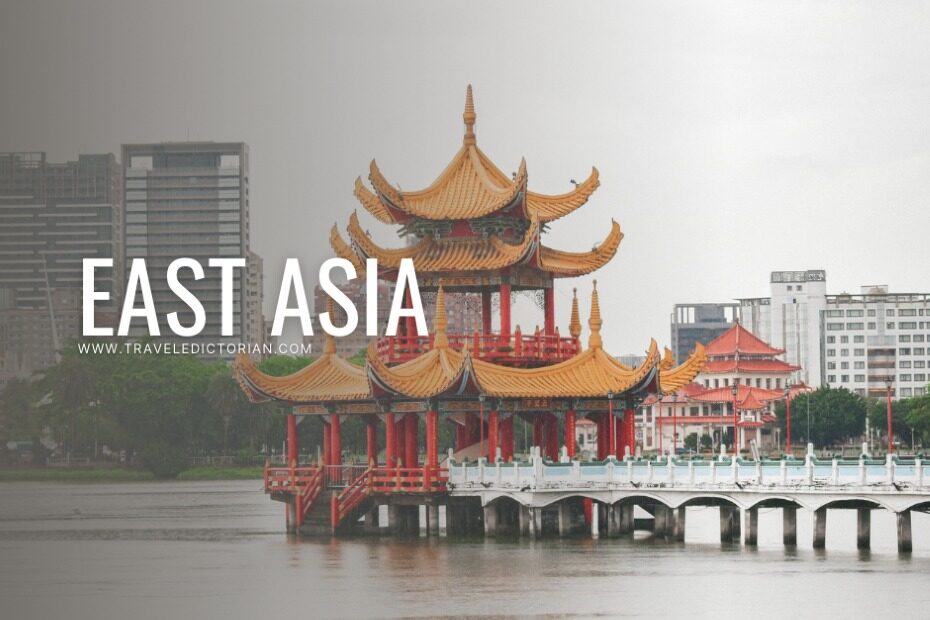
This article, “43 Intriguing Travel-Related Facts About East Asia,” features tidbits that add a layer to understanding the rich tapestry of the Asian subregion.
Disclaimer: This travel guide contains information that is subject to frequent updates. That being said, if you opt to read this article further, you consent to verifying facts with the relevant authorities. Please review the full terms of this website.
Introduction
Existing for thousands of years, China was one of the earliest civilizations in the world. Being the cradle of Eastern culture, it wielded immense influence over Japan, Korea, and Mongolia. Through its shared philosophies, languages, writings, religious beliefs, culinary traditions, and architectural styles, China has, in fact, deeply cemented the foundation of East Asia.
The East Asian ancestry remains profoundly embedded, despite how rapidly the world is changing. Its illustrious ideologies, enduring customs, and historical monuments are ingrained in a world where modernity is at its height. Here are 43 intriguing travel-related facts about East Asia:
Climate and Topography
- China, together with Russia, shares a land border with 14 other countries, which is more than any country. The world’s third-largest country shares a boundary with Mongolia up north, Russia to the northeast, and North Korea to the east. Moreover, Mainland China also shares a border with Kazakhstan toward the northwest and Kyrgyzstan, Tajikistan, Afghanistan, and Pakistan to the west. Moreover, China adjoins India toward the southwest. Nepal, Bhutan, and countries in the Southeast Asia, such as Myanmar, Laos, and Vietnam, lie south of China.
- The People’s Republic of China, which spans a geographical reach of roughly 3.6 million miles, observes a centralized time zone, the CST. In contrast, the contiguous United States, which has marginally the same spatial extent, has four standard time zones. The reason for having a unified time zone is to allow a more cohesive approach to governance and trade.
- Hong Kong has the highest concentration of high-rise buildings, skyscrapers and supertall structures in the world. The most vertical region features an overwhelming count of over 2,500 buildings clustered throughout its territory’s constricted space, making it one of the most fascinating facts about East Asia.
- Macau is a special administrative region of China. The Chinese territory covers slightly more than 33 square kilometers, making it as one of the smallest regions in the world. Because of its compact size with about 720,000 inhabitants, Macau, which is also a tourist-saturated city, is the world’s most heavily populated region. It approximates to 23,000 people per square kilometer.
- Ulaanbaatar is the coldest capital on Earth. The Mongolian capital, which settles in a valley and receives intense Siberian air, braves below-freezing mean temperatures. In the 1950s, the temperature plummeted to roughly -40°C, the lowest ever recorded in the capital, making it one of the most unbelievable facts about East Asia.
- The Republic of China, often known as Taiwan, is widely regarded as the world’s most mountainous island. the territory has the highest concentration and density of high-altitude ranges, with 268 of them rising above 3,000 meters, encompassing about two-thirds of the fairly small area.
Customs and Laws
- Kim Il Sung, the founding leader of the Democratic People’s Republic of Korea, or just North Korea, conceived the ideology of “Juche” as the guiding principle for the state. This political belief emphasizes self-reliance and autonomy in various facets of governance, distancing itself from foreign influence and control.
- In North Korea, power outages are very common that households are only able to utilize a few hours of electricity every day to make room for production facilities to maintain operations.
- North Korea allows photography, but it is closely regulated. Thus, refrain from taking photos of construction sites, impoverished neighborhoods, and, most importantly, those uniformed personnel, making it one of the most strange facts about East Asia.
Events
Here are some fascinating facts about East Asia for events:
- In China, over 9.5 billion cross-regional transits occur during the “Chunyun” period, or “Spring Festival” travel rush. Slightly over half a billion internal migrant workers from urban centers, like Shanghai, return to their provincial hometowns, resulting in the largest exodus, or mass departure in the world.
- Hong Kong boasts the largest permanent light and sound show in the world, the “Symphony of Lights.” The free nightly spectacle, which pulls in crowds of spectators, showcases static lights, lasers beams, and sounds expertly orchestrated against the dramatic skylines of the city, making it one of the most impressive facts about East Asia.
- Japan has the highest number of recorded seismic events in the world because of its location at the intersection of tectonic plates. As part of the initiative, the country has engineered sophisticated seismic instruments and a countrywide emergency notification system.
Food and Retail
- With over 8,000 cafés spread out all across the metropolis, Shanghai has more coffee shops than any other city in the world.
- “Ozone,” which is housed at the opulent The Ritz-Carlton, is the highest rooftop bar worldwide. This party-atmosphere spot is lodged on the 118th floor of the 484-meter International Commerce Center, in West Kowloon, Hong Kong, making it one of the most fascinating facts about East Asia to hangout.
- Tokyo, Japan has more Michelin-starred restaurants than any city in the world. The Japanese capital boasts over 200 starred premier dining spots, such as “Kadowaki” and “Nihonryori Ryugin.”
- Tokyo’s Toyosu Market, occupying 407,000 square meters, has established itself as the largest wholesale market for seafood and farm produce in the world. It holds the internationally recognized tuna auction, where a single bluefin tuna was sold for a staggering 510 million yen or USD 3.2 million) in 2026 – the highest bid ever paid for a bluefin tuna. This public sale makes it one of the phenomenal facts about East Asia.
- Japan has more vending machines than anywhere in the world. There are between 2.5 million and 5 million automated retail kiosks in the country, which has a total population of roughly 122.4 million as of 2026. This means that it is likely to have one machine for every 24 to 49 people, making it one of the most fascinating facts about East Asia.
- The “UNESCO Creative Cities Network” recognizes Macanese cuisine, a fusion of Portuguese culinary techniques with blends of homegrown ingredients from Asia and Africa, as the first cross-cultural cuisine. The Macanese cuisine has been around for more than 450 years since Portuguese settlers arrived in Provincia de Macau in the 1500s, making it one of the most intriguing facts about East Asia for gastronomic experience.
- South Korea has the highest density of convenience stores worldwide, with “CU” and “GS25” sharing dominance in the market. There are around 55,000 C-stores in South Korea, which roughly equates to one store catering to 938 customers.
- The Shinsegae Centum City in Busan has been recognized by the Guinness World Records as the world’s largest department store in the world, spanning an immense floor area of nearly 300,000 square meters. The retail facility features a broad range of retail, dining, and recreational options.
- Chun Shui Tang, a teahouse at 30 Siwei Street, Taichung, purportedly created the well-liked beverage “boba milk tea.” It was brought into being in 1983.
Lodging
- China is home to the world’s highest hotel, the J Hotel Shanghai Tower. Its luxurious guest rooms, which include 165 standard and deluxe suites and 34 presidential suites, take up the upper levels and extend to the 120th floor of the Shanghai Towers, the third tallest building in the world at a staggering height of 632 meters, making it one of the most jaw-dropping facts about East Asia.
- Tucked away in the ranges of Minami in Yamanashi Prefecture, Nishiyama Onsen Keiunkan is the world’s oldest continuously operating lodging facility. Dating back to 705 AD, the family-run traditional Japanese inn, or “ryokan,” has been in business for over 1,300 years. It’s already been passed down through over 50 generations.
- The world’s first capsule hotel, Capsule Inn Osaka, opened its doors in 1979. It is a men-exclusive overnight stay facility in the Umeda District, Osaka, Japan, with self-contained sleeping pods, spa, and on-site dining.
- The Henn-na Hotel in Nagasaki, Japan, which roughly means “a strange or weird hotel,” is the first robot-staffed hotel in history. It employs a squad of automatons that assist in front-desk reception, luggage storage, and in-room service, making it one of the most out-of-this-world facts about East Asia.
Places of Interest
- The “Great Wall of China” is the longest continuous man-made defensive wall in the world, spanning slightly over 21,000 kilometers. This monumental network of ramparts, also recognized as one of the “New Seven Wonders of the World,” is a fraction over half the length of the Earth’s circumference.
- Shanghai Tower is home to the world’s tallest observation platform. It sits at a commanding height of 561.3 meters on the 121st floor of China’s tallest building, which makes it one of the most incredible facts about East Asia for places worth to visit.
- Shibuya Crossing in Tokyo is officially the world’s busiest pedestrian crossing. Close to three million pedestrians converge in the hectic intersection in a single day.
- Macau, which is known for its moniker, the “Las Vegas of the East,” rose to become the most successful gambling destination in the world. The city’s betting and gaming sector generates about 80% of economic gains, which is three times as much as Las Vegas’ gaming revenue.
- The Skypark Macau Tower, located on the 61st floor of the tallest structure in the city, holds the highest commercial bungee jump and urban tourist climb in the world – an extreme sports venue for thrill seekers.
- The Bogd Khan Uul National Park, situated southward of Ulaanbaatar in Mongolia, is regarded as the oldest nature reserve in the entire world. The extensive protected area was officially established in 1778.
- Mongolia is home to the largest equestrian statue in the world, the “Genghis Khan Equestrian Statue,” with an impressive height of 40 meters. The massive 250-ton stainless steel sculpture was built to honor the greatest conqueror in history.
- The “Korean Demilitarized Zone,” or “DMZ,” is a stretch of land that splits North Korea from South Korea on the Korean Peninsula. This demarcation line, measuring 250 kilometers long and 4 kilometers wide, is the most heavily militarized border in the world. It is manned with over a million armed personnel, crammed with military hardware, and lined up with defensive bastion barriers, making it one of the most overwhelming facts about East Asia.
- TAIPEI 101 holds a few world records, including the first skyscraper to reach a height of more than half a kilometer and the tallest green building in the world. In addition, the engineering feat contains the world’s largest tuned mass damper built to withstand seismic activity.
- The National Palace Museum in Taipei has the world’s largest collection of Chinese artifacts and artworks. Close to 700,000 valuable articles, including paintings, jade carvings, calligraphic and literary works, and ceramics, are on permanent display.
Transit
- Located southwest of mainland China, the Chongqing East Railway Station is the world’s largest rail station. The enormous transport hub, which is outfitted with 29 railroad tracks, including 15 rail platforms, spans 1.22 million square meters, or about the size of 170 football pitches, making it one of the truly remarkable facts about East Asia.
- At a length of at least 60,000 kilometers, China boasts the longest high-speed rail, or HSR, network. It is much larger than the entire world combined. Other than that, the “Beijing-Guangzhou line” surpasses 2,000 kilometers to become the world’s longest rail track.
- The Hong Kong–Zhuhai–Macau Bridge in China is the world’s longest sea-crossing bridge. It connects Hong Kong, Zhuhai in mainland China, and Macau SAR over a distance of 55 kilometers across the Pearl River Delta.
- Hong Kong SAR is home to the longest outdoor covered escalator in the world, the “Central-Mid-Levels Escalator.” The moving stairs extend over 800 meters, serving thousands of commuters from the Queen’s Road Central to Conduit Road on Hong Kong Island.
- Japan has a highly reliable railway system and the most on-time schedule. On rare occasions, the rail company will hand out a delay certificate, or “chien shōmeisho,” in case of running behind the timetable or late arrivals even if it takes under a minute, making it one of the most admirable facts about East Asia.
- Japan is home to the busiest rail station in the world, the Shinjuku Station. The train station, which has extensive routes across the capital and its neighboring cities, serves over 3.5 million daily commuters. It is located in Shinjuku Ward, an economic core and a significant transit hub of Tokyo.
- In Mongolia, horses have outnumbered the human population. The country has the highest horse-to-human ratio, with over 5 million Mongolian horses and roughly 3.5 million inhabitants, or about 10 horses for every 7 Mongols.
- The busiest flight route in the world is the air corridor between the Jeju International Airport (CJU) with Gimpo International Airport (GMP). More than 200 daily flight services are routinely traveling from the airway, bridging Jeju with the South Korean capital, Seoul.
Did I quench your curiosity about the 43 intriguing travel-related facts about East Asia? I’d love to hear what caught your attention the most. Share your thoughts in the comment section.

About the Author
J. Sac is the author of “43 Intriguing Travel-Related Facts About East Asia.” He is also the founder of Traveledictorian – a travel blog that publishes well-thought-out travel content.
His passion for writing, photography, and travel fueled him to explore Asia and the rest of the world. He also plans to undertake humanitarian work in his travels. Read his inspiring story and follow him on social media!
P.S. Subscribe to our newsletter for the newest travel guides and the latest updates in the travel industry.